Checkout Usability
Part of Checkout technology for Australian merchants
Choosing checkout requirements from the buying journey
Turn basket, fulfilment, payment and confirmation moments into clear checkout requirements and acceptance criteria.
Build checkout requirements from what buyers need to decide and provide, in the order they encounter those moments. Start with the store’s actual products, delivery options and payment paths. At each point, state what checkout must show, ask or retain.
Select distinct journeys
Choose a small set that covers how the store sells: perhaps a delivered item, a collection order and a product with special fulfilment conditions. Add a subscription or overseas sale only if offered.
Follow each journey from basket to the confirmation the customer receives. Note what the buyer needs to know, what the store needs to know, and which choices change the amount payable.
A collection order may need no delivery address. A delivered order may need a location before the store can quote eligible services. A returning buyer may need to review saved details. Check these possibilities against the merchant’s actual operation instead of treating one journey as the default for every sale.
Turn buying moments into requirements
| Buying moment | Question | Requirement to consider |
|---|---|---|
| Basket review | Are the items and current amount clear? | Show quantities, discounts and a clearly labelled subtotal or total. |
| Fulfilment choice | What information is needed to offer a service? | Ask for relevant address or collection details, then show eligible choices. |
| Payment review | Has a choice changed the amount payable? | Show the updated total and charge currency before payment. |
| Error or interruption | What can the buyer correct? | Retain safe, valid details and explain the next action. |
| Confirmation | What is known about payment now? | Distinguish an accepted payment from one still being processed. |
For Australian sales, treat price-display obligations as a separate review point. The ACCC provides information but does not give legal advice to businesses.
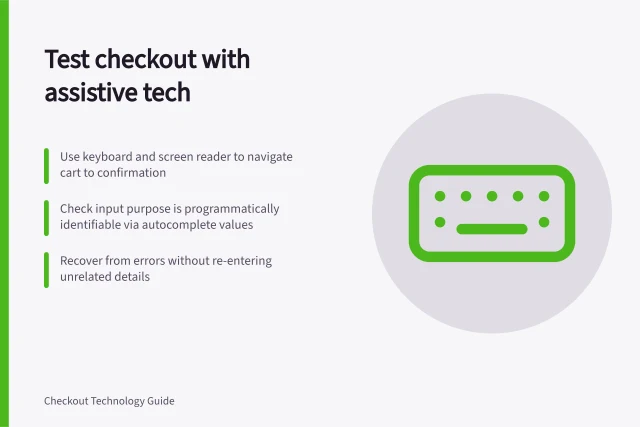
Include accessible form behaviour in the brief. W3C guidance calls for the purpose of covered personal-information inputs to be identifiable programmatically where the technology supports it. Visible labels still help buyers. If the form detects an input error, identify the affected item and describe the error in text.
Key Buying Moments in the Australian Checkout Journey
- Basket ReviewEnsure items, quantities, discounts and totals are clearly displayed. Use Australian English terms like 'subtotal' and 'total'.
- Fulfilment ChoiceCollect relevant address or collection details; show eligible delivery or pickup options based on postcode.
- Payment ReviewDisplay updated total and charge currency before payment. Ensure compliance with ACCC price display rules.
- Error or InterruptionRetain valid data and provide clear error messages that explain how to fix issues.
- ConfirmationClearly distinguish between a confirmed payment and one still being processed. Include GST and ABN where applicable.
Accessibility & Compliance Essentials for Australian Checkouts
- Form Input Purpose
- Identify programmatically using WAI-ARIA attributes where supported.
- Error Identification
- Visible labels + text-based error descriptions required for accessibility.
- ACCC Price Display Rules
- All prices must be clear, inclusive of GST, and shown upfront.
Record why each requirement matters
A useful record contains the journey, customer need, required behaviour, owner and way to check it. For a delivered order, a postcode change might need to update available delivery services and the payable amount before payment. Assign responsibility for that behaviour and use an appropriate address when checking the candidate flow.
Mark a requirement essential if the journey cannot finish correctly without it, conditional if it applies only to a named product or fulfilment route, and optional otherwise. If requirements conflict, such as requesting less information while calculating an exact delivery quote, identify the point where more information becomes necessary.
The resulting brief should let a vendor or developer walk through the purchase in sequence. A separate payment-step map can then describe provider events and order-state changes behind that buyer-facing journey.