Checkout Usability
Checkout pricing transparency
Show a clear checkout total across delivery, tax, currency, subscriptions and fees, with Australian price-display rules in view.
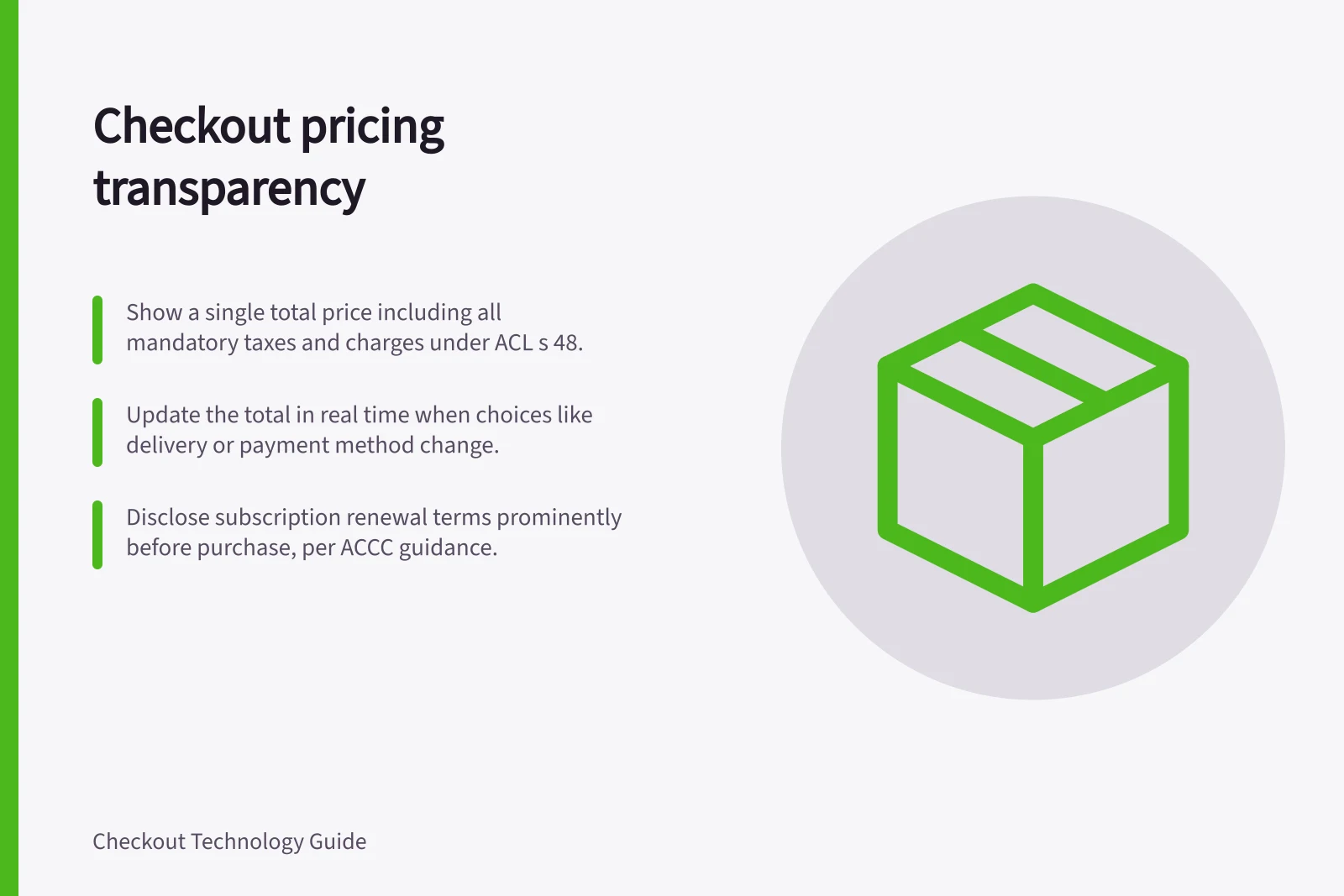
Show a clear minimum total price, including applicable taxes and charges the shopper cannot avoid, before they book, order or purchase. Under Australian Consumer Law (ACL) s 48, accompany a quoted price with the single total price, prominently and as a single figure. As choices change the amount, update it before the shopper commits and confirm the itemised total at final order review.
This overview covers delivery pricing, currency, subscriptions and card surcharges at a high level. Continue to the focused article on each topic for deeper guidance.
Keep the total clear throughout checkout
Use consistent labels for items, discounts, delivery and other charges from the product page through confirmation. Keep one prominent total alongside the order review, and show any change where the choice that caused it is made.
A part price may also be displayed, but keep the single total at least as prominent. The eHarmony decision illustrates the importance of showing the minimum total as one price that brings together the components the shopper cannot avoid.
Once paid delivery is selected and its cost is known, include it in the checkout total.
Make the arithmetic visible at review: item price, applicable tax, selected delivery and any payment surcharge together make the total payable. Show whether applicable tax is included in the item price or shown separately, and update the total when a choice changes it.
Key requirements for checkout pricing transparency in Australia
- Show a single, clear total including tax and unavoidable charges
- Update the total in real time when choices change (e.g. delivery, payment method)
- Label all charges clearlyitem price, tax, delivery, surcharges
- Disclose currency of final charge and potential international transaction fees
- For subscriptionsshow minimum term, renewal terms, and total cost if calculable
Explain charges that depend on a choice
Show delivery options and prices before payment. If an address is needed to calculate a rate, say so and label an early amount as an estimate if it may change. If a rate is unavailable, prompt an address correction or another fulfilment choice rather than showing an unexplained zero.
Identify the currency the shopper will actually be charged in. An A$ display does not establish that payment is processed in Australia or rule out an issuer’s international transaction fee. If overseas processing makes such a fee likely, alert the shopper before payment.
For a subscription, distinguish today’s payment from later charges. State the billing interval, any minimum commitment, a later price change and automatic renewal terms. If a fixed minimum term has a calculable total, show it prominently alongside any monthly price.
Treat the subscription term and renewal as part of the price
On 25 August 2026, the ACCC reported that the Federal Court found eHarmony had misled consumers about the duration, pricing and automatic renewal of its online memberships.
The Court found that premium memberships presented as periods of 6, 12 or 24 months automatically renewed for a further 12-month lock-in period. Renewal prices could be up to five times the initial price, or hundreds of dollars more than the consumer had first agreed to pay.
The Court also found that eHarmony offered one-month memberships when the minimum period consumers could sign up for was six months. Monthly prices did not mention an additional mandatory fee, and claims of free dating misled consumers who could not communicate with others on an ongoing basis for free.
The Court found that consumers were given the false impression they could cancel early, when they could not. If renewal occurred, consumers often needed to keep paying for the full 12 months, even if they complained immediately afterwards.
When presenting a subscription, make the offered term and any subsequent commitment understandable alongside the price. Check that a displayed monthly amount does not hide a longer minimum period or a mandatory fee that changes what the consumer must pay. The Court found eHarmony had not displayed the minimum total as a single price alongside its monthly prices.
Make renewal disclosures visible before purchase
Put renewal terms prominently in the purchase journey where the shopper is assessing the commitment. In the eHarmony case, the Court found automatic renewal was not prominently disclosed: the terms appeared in small font late in the purchase process and in the terms and conditions.
The ACCC said consumers were not adequately informed about membership duration or automatic renewal, including renewal for many consumers at a much higher price. Do not rely on a late-stage or small-print disclosure to explain a material change in what they will pay.
The ACCC reported that it brought the eHarmony proceedings after receiving hundreds of consumer complaints.
Reconcile the final amount
Review mandatory, pre-selected, optional and payment-dependent charges separately. A mandatory fee belongs in the minimum total when it can be quantified, while an optional charge belongs beside its choice. If the final amount changes, identify the choice or condition that caused it.
The ACCC says it does not enforce the ‘no surcharge’ rules for card networks, resolve individual pricing complaints or provide legal advice about card network rules. Where a card surcharge applies, show it beside the payment choice so the shopper can see how it affects the total.
Steps to ensure compliant pricing display during checkout
- Display minimum total price earlyincludes tax, mandatory fees, delivery
- Update total dynamically when shopper selects delivery or payment method
- Clearly separate mandatory vs. optional charges
- Show card surcharge beside payment option, not hidden in fine print
- Reconcile final amount before confirmationexplain any changes
Know where to raise price-display concerns
The ACCC accepts reports about possible price-display problems and can investigate. It does not give legal advice on how to display prices or resolve individual disputes.
ACCC enforcement actions on pricing transparency (2023–2026)
- Number of consumer complaints received by ACCC related to pricingHundreds
- Case example: eHarmony settlement outcomeFederal Court found misleading conduct; required full disclosure of renewal terms and pricing
- ACCC role in pricing disputesInvestigates, enforces ACL; does not resolve individual complaints or give legal advice
In this guide
- Showing delivery costs before the final payment stepFind when to calculate delivery, show priced options and prevent an unexplained charge at the final payment step.
- Handling taxes and currency presentation clearlyShow a tax-inclusive consumer total, name the charged currency and explain when an A$ display may still involve overseas processing.
- Explaining recurring charges at checkoutShow the first charge, later billing, minimum commitment and renewal terms before a shopper starts a subscription.
- Removing unexpected fees from the final order screenAudit mandatory, optional and payment-related fees so the final order total confirms a price the shopper has already seen.