Checkout Usability
Part of Cross-border checkout
Handling international address formats
Design overseas address fields around the destination, allow corrections and check the saved address through delivery and label creation.
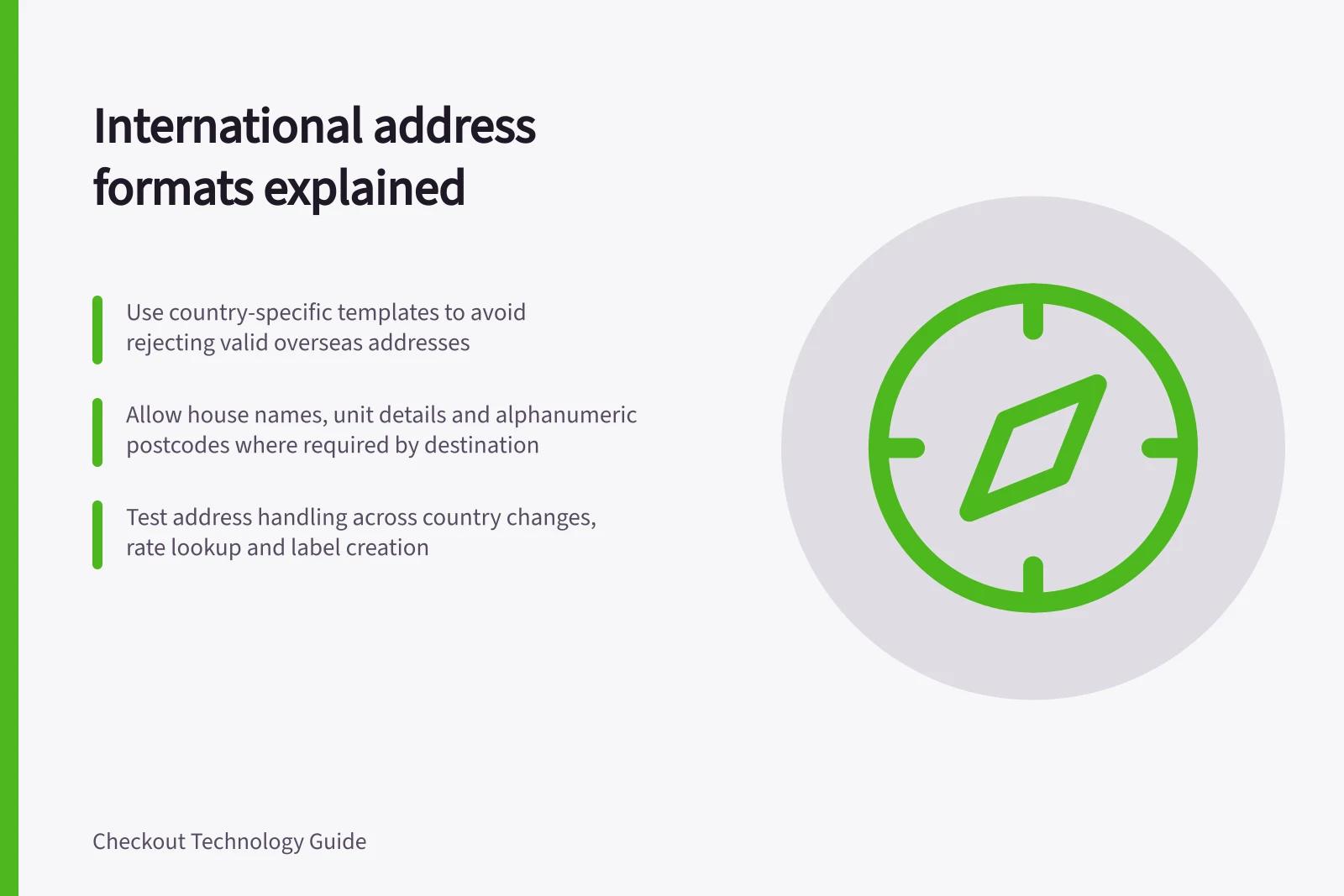
Ask for the destination country before showing address fields or applying validation. Address order and required details differ between countries, so an Australian template can reject or distort a valid overseas address.
Keep the buyer’s complete address available for the selected delivery service, and check that the saved order can be used to create its label.
Let the country guide the form
Address structure, content and level of detail vary. United States, United Kingdom and France addresses put the house number before the street name; Germany and Switzerland put the street name first. Let buyers enter address details in the order that suits the destination rather than requiring every address to fit an Australian sequence.
Some destinations use alphanumeric postcodes, while others do not use postcodes. For Canada, include the applicable alphanumeric postcode in the delivery address. A UK rural address may use a house name followed by village, town and postcode, with no street name or number: Trelissick House Feock Cornwall, TR3 6QL.
Allow address lines for details such as a house name, building, unit or district, and do not require a street number where the destination format may not use one. Make region and postcode fields conditional on destination guidance and the selected service; do not require an Australian state or four-digit postcode for every buyer.
Use the W3C guidance “Address formats around the world” alongside guidance for destinations served and the selected carrier’s requirements. ISO 3166-1 alpha-2 is used for the country code in the IMO agent-country-code data element; validate region details separately according to the destination and service.
Keep the country field easy to change without discarding other valid entries. Show useful destination-specific labels for region and address fields, and let the buyer review the complete delivery address before finishing the order.
Allow correction without losing detail
Treat autocomplete as an editable suggestion: it may omit a unit or select a nearby place. If postcode and locality conflict, identify both fields and ask the buyer to review them rather than silently choosing one value or rewriting the address.
If the shipping system needs a normalised address, retain the buyer’s original entry as well. This gives the merchant enough detail to investigate differences between the entered address and the version prepared for delivery.
Filled required fields do not prove that an address is deliverable. A service may exclude a destination or require contact details or a label format that the storefront has not checked, so confirm that the intended service can quote the route and create its label before offering it.
For Australia Post, complete the customs form online for available services, then show the confirmation QR code when lodging the parcel at the Post Office. Ask for the contact information required by the selected service rather than imposing one carrier’s fields on every overseas order.
At handoff, map the saved country, address lines and locality, plus any region, postcode and service-required contact details, to the corresponding fields accepted by the selected service. Keep the full buyer-entered address available in the saved order for checking against the label.
Check representative addresses
Test the different house-number orders with “123 Main Street” for the United States, United Kingdom or France and “Sternengasse 3, 35108 Allendorf, Deutschland” for Germany or Switzerland. Check that each destination accepts its postcode and that the address order is preserved.
Test a UK rural address with “Trelissick House Feock Cornwall, TR3 6QL” and a Canadian address with its applicable alphanumeric postcode. Check that a house name can be entered without a street number and that the postcode is not treated as digits only.
For an address using a distance from an intersection, test “Calle 122 # 18 – 15” as a Colombian example. For Kyoto, test the intersection-based address with its cardinal directions: 京都市下京区 Kyōto-shi, Shimogyō-ku; 烏丸七条下ル Karasuma-Shichijō-sagaru; 東塩小路町 721-1 Higashi-Shiokōji 721-1.
For each case, change the country after entering the address and check what the form retains. Follow it through rate lookup, the saved order and label creation; record which step rejects an address and why.
Pass a test only if the complete address remains available in the saved order and can be mapped to the selected service’s delivery label.