Checkout Usability
Part of Changing a checkout or payment provider
Running a controlled rollout of a new checkout
Choose eligible checkout traffic, retain routing through retries and use payment and order checks to decide when to expand.
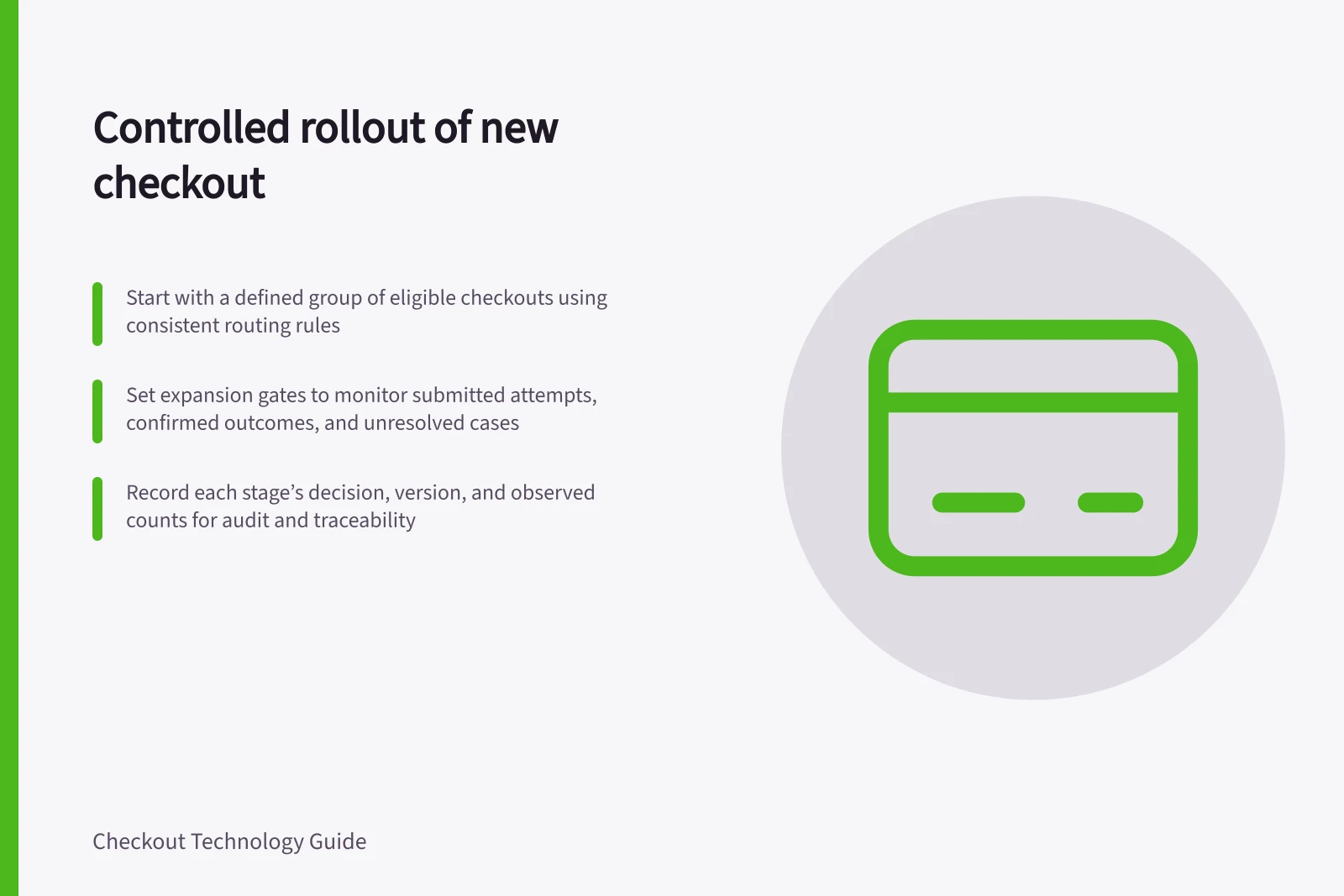
Start with a defined group of eligible new checkouts. Check whether their payments produce the correct orders, then widen access only after agreed conditions pass. Keep each checkout's assigned provider through refreshes, redirects and retries so one order does not unexpectedly enter both routes.
Choose and retain an eligible segment
The first group could be a particular store route or a small, consistently assigned share of eligible checkouts. Include only purchase journeys the new integration supports. Hold a method, currency, subscription or fulfilment path outside the group until its complete handling is ready. Record the eligibility rule and who can change it.
Save the assigned route with the checkout or order reference. If a buyer retries, keep the route unless the earlier attempt has been resolved and an operator deliberately changes it. A refresh should not silently create another order. If the earlier payment outcome is unknown, investigate it before offering a second charge route.
Set an expansion gate
Before live exposure, use a permitted test setup to check the current total, payment submission, failure, cancellation and order update. Include an external return or delayed outcome where an offered method can produce one. Use the selected provider's dependable outcome rule.
During live rollout, show counts as well as rates and review these signals by assigned route:
Signal / Question for the rollout owner
- Submitted attempts
- Are eligible buyers reaching a provider request?
- Confirmed outcomes
- Does each known result reach the intended order?
- Unresolved attempts
- Are pending or unknown states investigated before another charge?
- Amounts
- Do charged amount and currency match the reviewed order?
- Operations
- Can staff locate payments and use the right refund route?
Separate ordinary declines from faults that create requests or apply results. Compare against a relevant pre-change baseline. Do not infer a conversion improvement from a short, non-random release; traffic and offer differences may explain a change.
Before release, agree which faults stop expansion: an incorrect charge, an order released without its required payment outcome, a repeatable blocked purchase, or unexplained unresolved attempts above the store's tolerance. Name the owner who can pause routing and the condition for resuming. Widen one defined segment at a time.
Record the stage decision
For each stage, record the eligible population, routing rule, release time, version, observed counts, exceptions and decision to expand, hold or reverse future routing. Keep older orders tied to their original provider.
Where the chosen integration uses event notifications, confirm its delivery rules and make order updates safe against repeated or late events. A rollout stage is accepted when its payment and order records can be explained, including unresolved cases.