Payment Methods
Part of Payment method selection
Choosing payment methods from actual customer demand
Use customer requests and checkout signals to decide which payment methods merit investigation, without mistaking popularity for store demand.
Choose a payment method to investigate by finding a customer payment need your current checkout does not meet. Use requests and checkout records together. Neither a national popularity figure nor a method’s selection count proves that adding it will produce more orders.
Gather evidence about the buying task
Set a review period and collect relevant support contacts, checkout feedback and payment records. Note the purchase type and, where available and appropriate, whether the customer was eligible to see the option. Keep requests specific: someone asking to pay a recurring charge from a bank account may mean a different route from someone wanting to send a one-off transfer.
| Signal | Possible meaning | Limit |
|---|---|---|
| Repeated requests for a named option | Some customers recognise a missing route. | Requests do not establish how many would complete a purchase. |
| A shown option chosen but not completed | That route deserves investigation. | Failure does not establish the customer’s preference or its cause. |
| Few eligible shoppers shown a wallet | Configuration or eligibility may constrain reach. | A low display count does not show dislike. |
| Bank-payment requests for regular charges | There may be a recurring collection need. | The request does not establish which product or schedule is supported. |
Where the records permit it, distinguish shown, selected, submitted and confirmed. Check the provider result before treating an unsuccessful attempt as a preference signal. If the store cannot record visibility, say so; do not calculate demand as though every shopper saw every option.
Put national figures in context
The Reserve Bank of Australia’s 2025 Consumer Payments Survey found cards remained the most widely used consumer payment method. It also reported increased mobile-device use for in-person contactless card payments. That measure does not predict demand for a wallet button at a particular online store.
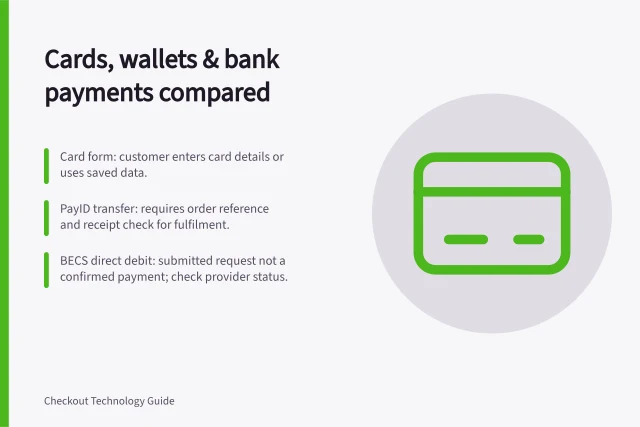
Clarify requests for “bank payment”. PayID is an identifier a customer can use when sending money through online banking. PayTo uses an agreement the customer authorises in online banking so a business can initiate payments within its terms. Ask which action the customer expects before treating these as the same request.
PayID vs PayTo: Key Differences for Australian Businesses
- Purpose
- Identifies a recipient for online bank transfers
- User Action Required
- Customer initiates transfer using PayID
- Business Role
- Recipient only – cannot initiate payments
- Purpose
- Enables businesses to initiate payments with customer agreement
- User Action Required
- Customer authorises recurring or one-off payments via online banking
- Business Role
- Initiates payments under agreed terms (e.g., subscriptions)
Key Findings from RBA’s 2025 Consumer Payments Survey (Australia)
- Most Widely Used Payment Method
- Cards
- Increase in Mobile Contactless Use
- For in-person purchases
- Note on Online Checkout Relevance
- Does not predict demand for wallet buttons on online stores
Decide what the evidence warrants
For each candidate, record the customer problem, supporting observations, affected purchase journey and possible route. Include an alternative explanation. A complaint about a missing method may turn out to be an existing option hidden from eligible shoppers; a failed card payment may be an error to fix rather than evidence for another button.
Check whether the platform and provider can offer the candidate to the affected customers, what account conditions apply and how the store would handle confirmation and refunds. If the evidence is thin, ask a short, neutral question through an appropriate customer channel. Treat the answer as stated interest, not a completed sale.
Mark the candidate enable, investigate further or defer, with a reason. For an enabled method, plan to check visibility, payment outcomes and whether the original complaint recurs. Revisit the decision when better store evidence becomes available.