Payment Methods
Payment method selection
Choose online payment methods using customer needs, actual availability, payment outcomes, costs and the work your store can support.
Choose payment methods that meet a customer need and that your store can take, confirm and support. For an Australian online store, card acceptance is a useful starting point to assess. Add a wallet or bank payment route when it serves a buying journey your customers use and its payment outcome can be handled reliably.
Shortlist methods against real orders
A card form and a digital wallet may look like different choices to a shopper. Apple Pay, for example, passes a token for an e-commerce credit or debit card authorisation.
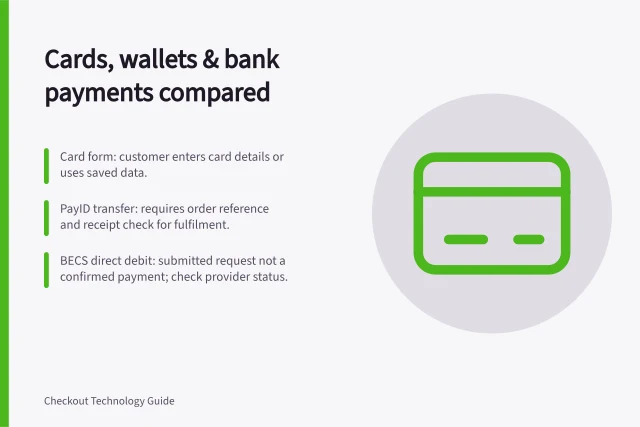
Bank payment routes differ more substantially. A customer can initiate a transfer using PayID, authorise a PayTo agreement in online banking, or give authority for a BECS direct debit. Each creates a different checkout and order-handling task.
The Reserve Bank of Australia's 2025 Consumer Payments Survey found that cards remained Australia's most widely used consumer payment method.
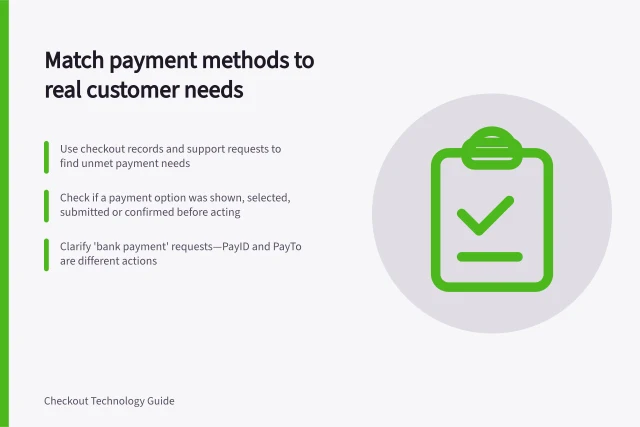
Review customer requests, the purchase journeys you offer and any checkout records that distinguish a method being shown, chosen and completed. A request for a new option may point to an unmet need. A failed attempt may instead point to a problem with an option already offered. Record which explanation has evidence before changing the method list.
Interpret survey signals at the right level
Use broad consumer-payment patterns to identify methods worth assessing, then check whether they suit the purchases and customer groups your store serves.
The survey found that debit cards were used for one in every two consumer payments.
It also found differences across groups: respondents aged 18 to 29 made around 80 per cent of their payments using cards, compared with around 60 per cent for those aged 65 and over.
Mobile-wallet use also increased across age groups. In the survey diary week, 43 per cent of consumers used a mobile device to make a contactless payment, up from 35 per cent in the 2022 survey.
When considering a wallet, check whether customers can use it on their devices and whether your merchant setup supports it.
Top Payment Methods by Customer Adoption in Australia
- Cards (Total)Most widely used payment method
- Debit CardsOne in every two consumer payments
- Mobile Contactless Payments43% of consumers (up from 35% in 2022)
- Credit Card Market GrowthHigher spending driving market expansion
Key Statistics on Australian Consumer Payment Behaviour
- Most Used Payment MethodCards
- Debit Card Usage Rate1 in 2 consumer payments
- Mobile Contactless Payments (Age 18–29)80% of payments
- Mobile Contactless Payments (All Consumers)43% use mobile devices for contactless payments
Check the whole payment path
| Decision | Question to answer |
|---|---|
| Customer fit | Which purchase and customer need does the method serve? |
| Availability | Can the intended customers use it through your platform, provider and account? |
| Payment outcome | Which reported status permits fulfilment, and what happens while payment is pending? |
| Store operations | Can staff trace an attempt, handle a refund and answer a query? |
| Cost | What does the current provider offer charge for your expected transactions? |
| Presentation | Can shoppers recognise the choice and understand the next action? |
For each candidate, verify the payment statuses available in your integration and whether staff can act on them. PayTo payments are processed fast 24/7, though some may be held for additional security checks.
BECS direct debit can take business days to confirm. A customer-initiated transfer needs a way to identify the order and confirm receipt. Do not apply one fulfilment rule to every bank payment.
Payment Methods in Australia: Usage, Timing and Support Requirements
- Most Common Use (RBA Survey 2025)
- Yes – most widely used method
- Customer Age Group Trend (18–29 vs 65+)
- 80% of payments (18–29) vs 60% (65+)
- Customer Initiation
- Card form or tokenised wallet
- Business Setup Requirement
- Standard card gateway; PayTo sponsorship required; PayID email setup needed
- Support for Pending/Failure Handling
- Yes – with clear status codes and notifications
Confirm access and responsibility
A method is a realistic candidate only if the route is available to your business and customers. For example, Apple Pay is compatible with most active Apple devices, while Google Pay lets users select a supported payment method saved to their Google Account. Check that your actual merchant setup supports the intended customer route before treating it as an offer you can make.
For PayTo, Australian Payments Plus says a business needs to be sponsored as a PayTo User to offer the method. The customer's agreement sets out terms such as amount, purpose and frequency, and is authorised in online banking.
Include the ability to identify agreement changes in your operational assessment: businesses can receive notifications when customers pause or cancel an agreement, as well as when payments succeed or fail.
For PayID transfers, consider how the customer will identify the recipient and how your staff will associate a payment with an order. A payer is shown the name linked to a PayID before sending, and some businesses provide a unique email PayID.
Make sure the instructions and order records support a clear payment journey rather than assuming a transfer will be self-identifying.
Align payment timing with fulfilment
Set fulfilment rules around the payment status your business can verify, not simply the method the customer selected. For example, BECS direct debit starts with customer permission through a Direct Debit Request; processing typically takes one to three business days, and a bank can return a failure message after funds appear to have moved.
If your delivery or service process cannot accommodate that timing, account for it before offering the route.
Make and revisit the decision
Mark each candidate offer, investigate or defer. Offer it when the customer use case, availability, reported outcome and support process are clear. Investigate credible demand when account terms or order handling remain unknown. Defer a choice supported only by a broad market trend.
Before enabling a method, specify the purchase, cancellation, failure or pending state, refund and staff record that need checking through the platform's permitted process. Review customer requests and payment outcomes after release.
Assign an operational owner
The owner should monitor payment outcomes, coordinate staff support for pending or failed payments, and review customer requests after a method is added.
In this guide
- Cards, wallets and bank payments compared for merchantsCompare card forms, card wallets, PayTo, PayID transfers and BECS direct debit by customer action, confirmation and merchant workload.
- Choosing payment methods from actual customer demandUse customer requests and checkout signals to decide which payment methods merit investigation, without mistaking popularity for store demand.
- Showing payment options without cluttering checkoutPresent payment choices with clear labels, eligible wallet buttons, concise instructions and accessible controls.