Payment Methods
Part of Payment method selection
Cards, wallets and bank payments compared for merchants
Compare card forms, card wallets, PayTo, PayID transfers and BECS direct debit by customer action, confirmation and merchant workload.
Cards, card wallets and bank payments differ in what the customer does and when the merchant can rely on the payment result. Compare the actual route your provider offers; a wallet button and a PayID transfer are not interchangeable alternatives to a card form.
| Route | Customer action | Merchant limit to check |
|---|---|---|
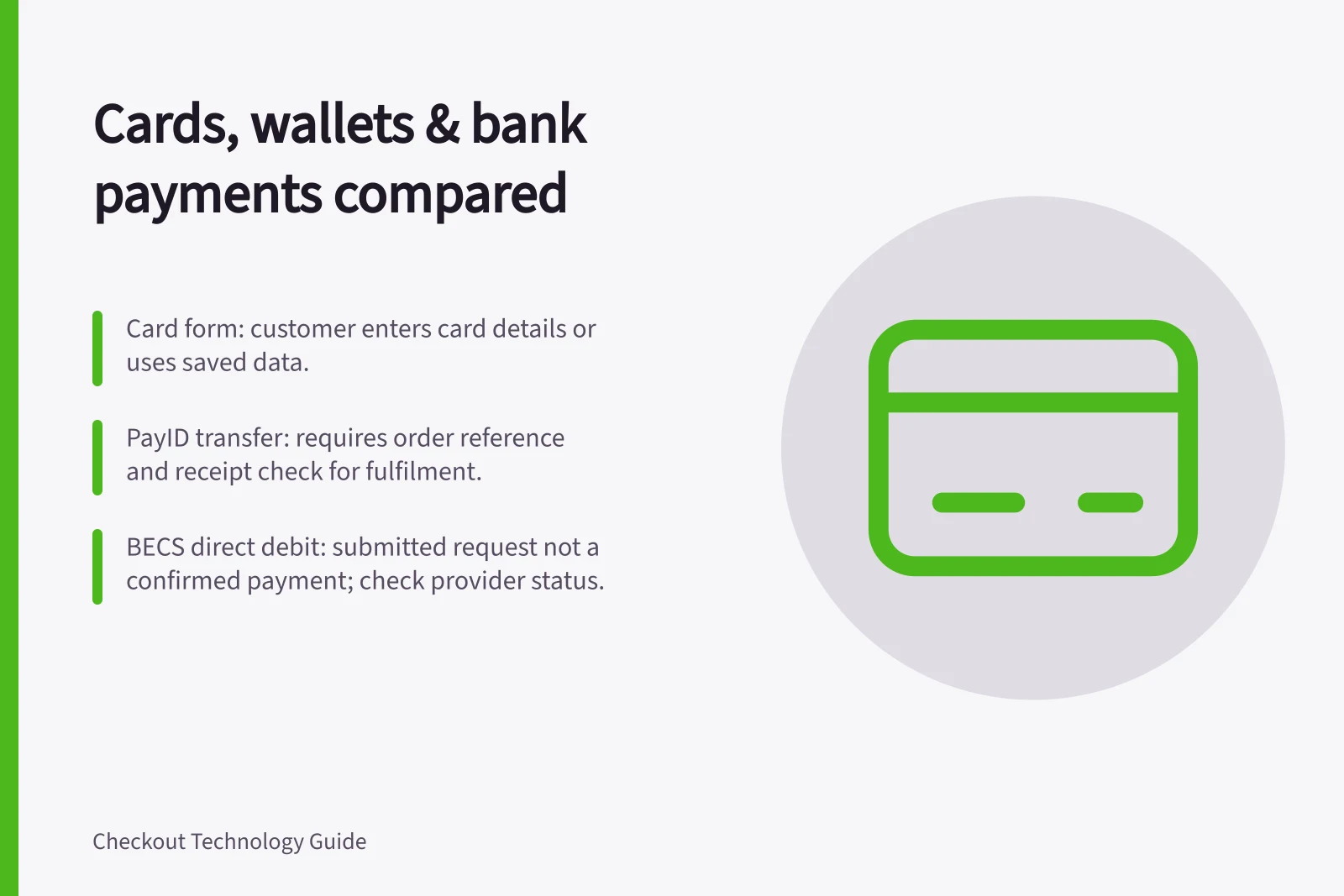
| Card form | Enters card details or uses details saved by the checkout. | Accepted cards, declines, refunds, reported status and contracted fees. |
| Card wallet | Selects a supported saved card in a payment sheet. | Shopper and integration eligibility; the fee and reporting treatment in the provider’s offer. |
| PayTo | Authorises an agreement in online banking. | An enabled PayTo arrangement, the agreement terms and the provider’s payment outcome. |
| PayID transfer | Initiates a transfer in online banking using the recipient’s PayID. | How the store identifies the order and confirms receipt; PayID alone is not a checkout confirmation service. |
| BECS direct debit | Gives authority for an account debit. | Business-day processing, later returns and the status used for fulfilment. |
Card form and card wallet
The Reserve Bank of Australia found cards were the most widely used consumer payment method in its 2025 survey. That result does not determine a card brand, wallet or fee plan for an individual online store.
Apple Pay’s documented flow sends an encrypted token for card authorisation. Google Pay’s web flow returns a token after the customer chooses a supported saved method.
Both can spare a shopper from entering card details again, but availability depends on the merchant integration and shopper setup. Neither wallet has a universal merchant fee: check the current provider agreement and transaction record.
Key Payment Method Insights for Australian Merchants
- Most common payment method (RBA 2025 survey)
- Cards
- Apple Pay tokenisation
- Encrypted for authorisation
- Google Pay web flow
- Returns token after card selection
- Wallet availability
- Depends on merchant integration and shopper setup
Three different bank routes
PayID is an identifier linked to a bank account. A customer uses it to address a payment sent through online banking. If a store accepts such transfers outside an integrated checkout, it needs an order reference and a reliable receipt check before fulfilment.
PayTo lets a business initiate payments under an agreement the customer authorises in online banking. Australian Payments Plus describes one-off, ad hoc and regular uses and says the business must be sponsored as a PayTo User.
It describes fast processing, but notes that some payments may be held for security checks. Use the actual provider outcome when deciding whether an order is paid.
BECS direct debit starts with customer authority and follows business-day processing. A debit can fail after submission, so a submitted request is not a confirmed payment. Ask the provider when it reports success or a return and how staff can investigate either outcome.
Compare an equivalent order
Ask the provider to show, for each route you might offer, the customer action, the statuses returned for success and failure, the point at which the order may be released, the refund path and the applicable fee schedule.
Record what its documentation supports and what needs account-specific confirmation. The right comparison is between usable payment paths, including the work after checkout.